
Google used to send people to websites. Now it answers questions directly — and only then links to the sources it trusted enough to quote.
That shift is why Answer Engine Optimization exists. If your site is not structured to be cited by AI, you are invisible in the fastest-growing part of search — no matter how well you rank traditionally.
What Is AEO?
Answer Engine Optimization (AEO) is the practice of structuring your content so that AI-powered search engines — Google AI Overviews, ChatGPT, Perplexity, Gemini — select your website as a source when generating answers.
Unlike classic SEO, where the goal is to rank on page one, AEO targets a different outcome: being the website that gets quoted inside the AI answer itself.
When someone searches «denver to red rocks car service» and Google generates an AI Overview, it pulls data from specific pages it considers authoritative, well-structured, and directly relevant. Those pages get cited. Everyone else gets skipped — even if they rank just below.
Why AEO Matters Right Now
Search behavior is changing faster than most businesses realize.
Google’s AI Overviews now appear on a significant portion of searches in the US, especially for informational and local queries. ChatGPT crossed 100 million daily active users. Perplexity is growing rapidly as a research tool among professionals. Gemini is integrated directly into Android and Google Workspace.
The pattern across all of them is the same: the AI reads multiple sources, synthesizes an answer, and cites 3 to 8 websites. If your site is not in that citation list, the user never sees you — they got their answer and moved on.
For businesses targeting high-value English-speaking markets, this is not a future problem. It is happening now.
AEO vs SEO vs GEO: What Is the Difference?
These three terms are related but not the same.
SEO (Search Engine Optimization) — optimizing to rank in traditional blue-link search results. Still important. Still the foundation.
AEO (Answer Engine Optimization) — optimizing to be cited inside AI-generated answers on search engines. Focused on Google AI Overviews, featured snippets, and similar surfaces.
GEO (Generative Engine Optimization) — optimizing to be cited by standalone AI tools like ChatGPT, Perplexity, and Claude when users ask questions directly. Similar principles to AEO but targeting a different set of platforms.
All three matter. But AEO is the most urgent for businesses already doing SEO, because it applies to the same Google surface they are already trying to rank on — just a layer above the traditional results.
Real Example: How AEO Works in Practice
Here is a live example from one of our clients, Mr. Chauffeur Colorado — a premium car service based in Denver.
When a user searches «denver to red rocks car service» on Google, an AI Overview appears at the top of the page. The AI synthesizes an answer covering pricing, vehicle types, travel time, and pickup logistics. Mr. Chauffeur Colorado is listed as the first source out of 8 websites cited.
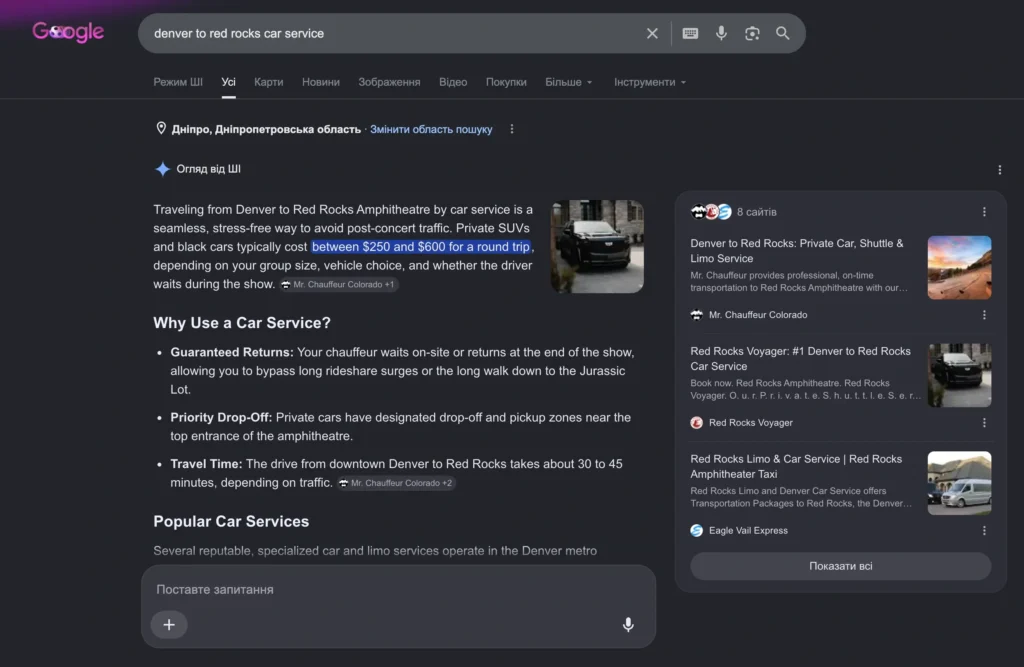
Google AI Overview citing Mr. Chauffeur Colorado as top source for «denver to red rocks car service»
This happened because the Mr. Chauffeur website had:
- A dedicated page for this specific route
- Clear, factual content answering the exact questions users ask (price range, drive time, what happens if the driver waits)
- Structured markup helping Google understand the content type
- Consistent NAP data and local signals
The result: visibility at the very top of the page, before any traditional organic results, without paying for an ad.
How Answer Engines Decide What to Cite
AI systems do not pick sources randomly. They evaluate several factors when deciding which pages to quote:
Relevance and specificity. A page that directly answers the question in clear, factual language beats a generic page that covers the topic broadly. The more specific your content matches the query intent, the better.
Content structure. AI models parse content more reliably when it is organized with clear headings, short paragraphs, and explicit answers. Long walls of text with no structure are harder to extract from.
Authority signals. Backlinks, brand mentions, reviews, and consistent information across the web tell AI systems that your site is trustworthy. A new site with no external signals rarely gets cited.
Factual density. AI Overviews love pages that contain specific data — prices, times, distances, steps, statistics. Vague content that never commits to a concrete answer is rarely cited.
Schema markup. Structured data (FAQ schema, LocalBusiness schema, HowTo schema) makes it significantly easier for AI to extract and use your content accurately.
How to Optimize for AEO: 6 Practical Steps
1. Answer questions directly and early
Do not bury the answer. If your page is about pricing, state the price range in the first two paragraphs. If it is about a process, lead with a clear summary. AI systems often pull from the opening section of a page.
2. Use FAQ sections — but rethink why you add schema
Add a FAQ section to every key page. Write questions exactly the way people search them — conversational, specific. Answer each one in 2 to 4 sentences with concrete information.
One important update: as of May 7, 2026, Google no longer shows FAQ rich results in Search. The expandable Q&A dropdowns under organic listings are gone for all sites. FAQ schema will not earn you extra SERP real estate anymore.
However, FAQPage markup still makes sense for AEO. Perplexity, ChatGPT, Gemini, and other AI crawlers still parse it when deciding what to cite. Keep the schema if your FAQ content is real and useful — remove it only if the questions were added purely to chase the SERP feature and have no value for readers.
3. Add structured data markup
Implement the schema types relevant to your business:
LocalBusiness— for location-based servicesFAQPage— for FAQ sectionsService— for specific services you offerArticleorBlogPosting— for content pages
Use Google’s Rich Results Test to verify your markup is correct.
4. Build topical authority
AI systems prefer sources that cover a topic in depth, not just a single page. If you want to be cited on «car service in Denver,» you need multiple pieces of content around that topic — route-specific pages, pricing guides, FAQ content, location pages.
For a digital marketing agency, this means covering your core topics (SEO, PPC, AEO) across multiple formats: service pages, blog posts, case studies, comparison articles.
5. Earn external mentions and links
Being cited by AI tools is partly about trust, and trust is partly built from what others say about you. Press mentions, directory listings, client reviews, backlinks from relevant sites — all of these contribute to the authority signals that influence whether AI systems trust your content enough to quote it.
6. Keep your content factually precise
Replace vague claims with specific data wherever possible.
Instead of: «We help businesses grow their online presence.» Write: «Our SEO clients typically see a 40-120% increase in organic traffic within 6 months.»
Instead of: «Prices vary depending on the project.» Write: «SEO retainers start at $1,500/month for local campaigns.»
Specificity is what AI extracts and quotes. Vagueness is what it skips.
Common AEO Mistakes to Avoid
Optimizing only for traditional rankings. High organic rankings no longer guarantee visibility if AI Overviews are answering the query above your result. You need both.
Writing for keywords instead of questions. AEO requires you to think about the actual question a person is asking, not just the keyword phrase. The intent behind «denver to red rocks car service» is «how do I get there, how much does it cost, and what should I expect» — not just a list of car services.
Ignoring structured data. Schema markup is not optional for AEO. It is one of the clearest signals you can send to help AI understand your content.
Thin content on service pages. A service page with 200 words and no specific details will never be cited. Expand service pages with real information: process, pricing range, timelines, FAQs, and results.
No external authority signals. A technically perfect page on a brand-new site with no backlinks and no mentions anywhere will still struggle to get cited. Build authority in parallel with on-page optimization.
Where to Start
If you are already doing SEO but have not thought about AEO, the gap in your strategy is likely in three areas:
- Your content is not specific enough — no prices, no timeframes, no concrete data
- Your service pages have no FAQ sections or schema markup
- You have no content strategy covering questions users actually ask
The good news: these are fixable without rebuilding your site from scratch. A structured content audit will tell you exactly which pages to update first and what to add to each one.
Get a Free AEO Audit
Not sure how your site performs from an AEO perspective? We review your key pages, check structured data, and identify the fastest opportunities to get cited in AI search results.
[Get Your Free AEO Audit — Contact Us]
No commitment. We will tell you what is there, what is missing, and what to do about it.
TwoX Digital is a digital marketing agency specializing in SEO, AEO, GEO, and PPC for businesses in the US and English-speaking markets.