
Local SEO Services
Get found in the Google Map Pack, on Google Maps and in AI answers - where local customers decide who to call.
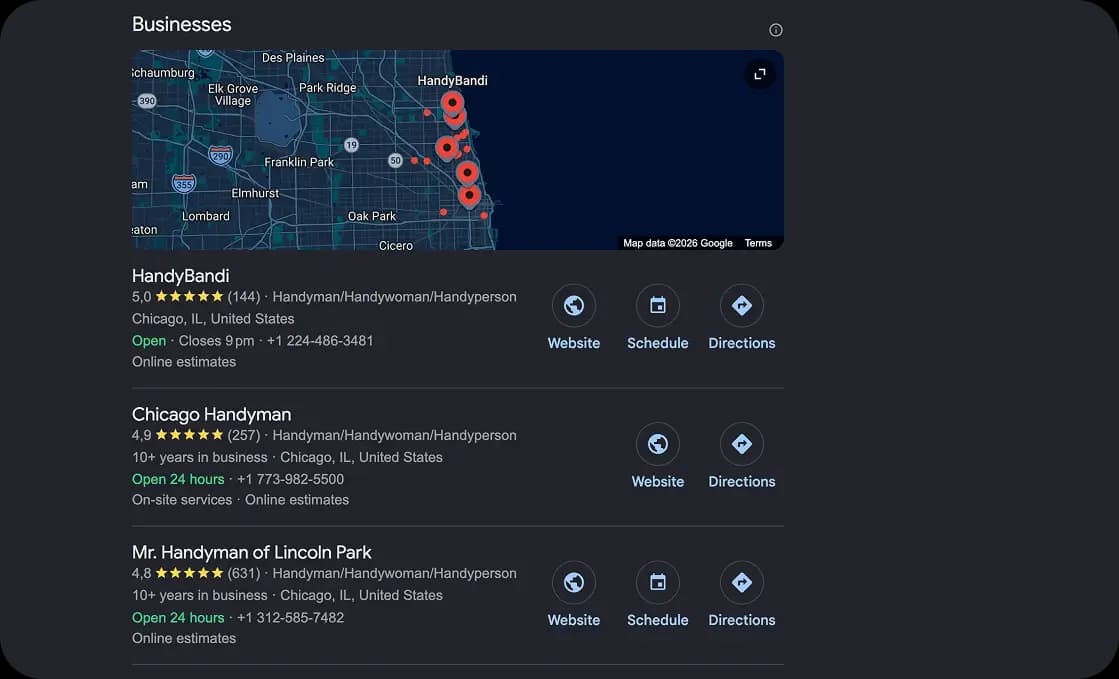
What Local SEO Actually Does
Local SEO is the work of making a business visible to people searching nearby — in the Google Map Pack, on Google Maps, and in the AI answers that now sit above both. It is measured in calls, direction requests and booked jobs, not in national keyword positions.
Regular SEO ranks pages. Local search ranks an entity: your Google Business Profile, the data about your business scattered across directories, your reviews, and your website — all weighted by how close you are to the person searching. Whitespark’s 2026 Local Search Ranking Factors report puts Business Profile signals at 32% of local pack weight, and our local SEO services start there for that reason.
Three situations fit this work: a business with a storefront customers walk into, a service-area business that travels to the customer, and a brand running the same playbook across 5, 50 or 500 locations. The mechanics differ in each case, and most of the failures come from applying the first playbook to the second.
Local SEO Services We Provide
Google Business Profile Optimization
Categories, services, attributes, photos and posts rebuilt around how local customers actually search - the biggest single Map Pack lever.
Citations & NAP Consistency
Audit and cleanup of your name, address and phone across directories and data aggregators, plus new citations that actually count.
Local Landing Pages
Location and service-area pages that rank on their own instead of duplicating each other with a swapped city name.
Reviews & Local Reputation
A repeatable system for earning and answering reviews, so volume and recency work as ranking signals instead of luck.
Multi-Location SEO
Profile management, page templates and reporting that scale across 5, 50 or 500 locations without pages cannibalizing each other.
Local SEO for AI Search
Getting your business into AI Overviews, ChatGPT and Perplexity answers, where a growing share of local discovery now starts.
Why us?
Why Work With Us on Local SEO
Map Pack, Not Just Rankings
We optimize what decides the Map Pack: the profile, the data behind it, and reviews. Your position in organic results follows from that work — it is not the number we build the plan around.
Geo-Grid Reporting
You see a grid of ranking points across your service area, not one averaged position. It shows the blocks where you appear, and the blocks where a competitor owns the pack and you are invisible.
Built for Service-Area Businesses
No storefront is not a problem, it is a protocol: hidden address, correctly drawn service area, regional pages that do not duplicate each other. Done the usual way, it is the fastest route to a suspended profile.
AI Visibility Included
The data that feeds the Map Pack also feeds AI Overviews and ChatGPT — but with different weights. Whitespark’s 2026 report puts your website at 24% of AI visibility against 12% for the profile. We work both.
Transparent Scope and Pricing
Local SEO pricing is published on this page, and every retainer comes with a month-by-month list of deliverables. You know what is being done and what it costs before the first call.
Proven, With Numbers
A new salon with no brand, no reviews and no ad budget reached #1 in the Map Pack in six months. The full breakdown, including what we tried that did nothing, is published on our blog.
How Google Decides Which Local Businesses to Show
Google names three factors for local results, and they have not changed in years:
- Proximity — how far you are from the person searching, or from the place they typed in. You cannot change it, and in most markets it outweighs everything else.
- Relevance — how well your Business Profile matches the query. The primary category does most of this work, then services, description and attributes.
- Prominence — how well known your business appears to be: review count and recency, citations, links, press coverage, branded searches.
Since proximity is fixed, the whole job is relevance and prominence — and then widening the radius at which those two outweigh distance. That is why our local SEO services report on a geo-grid instead of an average position: an average hides the fact that you rank third on your own street and nowhere five miles out.
Two things get misread constantly. Being closed at the moment someone searches suppresses you, so opening hours and holiday hours are a ranking issue rather than an admin detail. And stuffing keywords into the business name does work for the competitor above you — right up until the profile is edited back or suspended.
Google Business Profile Optimization
The profile is the ranking asset. Most local SEO work starts here, so we rebuild it field by field.
- Categories. One primary plus up to nine additional. Primary carries more relevance weight than any other single field, so we test it against what is actually ranking in your pack instead of picking the closest-sounding label.
- Services. Entered as individual items with their own descriptions, not listed inside the business description. Each service is a separate surface Google can match a query against; a paragraph mentioning the same words is not.
- Attributes. Several of them work as filters in Google Maps. Leave «wheelchair accessible» or «women-owned» unset and you disappear from those filtered results regardless of your ranking.
- Q&A. The one part of your profile competitors can also write in. We seed and answer the questions customers ask, before somebody else answers them for you.
- Hours, products, photos and Posts. Hours because a closed business ranks lower. Products because they get indexed even for service businesses. Photos and Posts on a schedule — they rarely move a position by themselves, but they feed the AI systems now reading profiles.
What we do not do: put keywords in the business name. It is the most common cause of suspension, and the position it buys is temporary.
Citations and NAP Consistency
A citation is any mention of your business name, address and phone number outside your own site. They stopped being a growth lever years ago and became a hygiene requirement: inconsistent data makes Google less certain which entity you are, and that uncertainty costs positions you would otherwise hold.
What a NAP audit finds
Usually the same four things. A duplicate profile created years ago by a former employee. The address from two offices ago, still live on a dozen directories. A call-tracking number in place of the real one. And a legal name in one place with a trading name in another.
We clean the sources that feed everything downstream first — Data Axle, Foursquare and Neustar Localeze push business data into hundreds of smaller sites — then the platforms customers and AI systems actually read: Google, Apple Business Connect, Bing Places, Yelp, Facebook, and the directories that matter in your industry, such as Healthgrades for clinics, Avvo for law firms, or Houzz and Angi for home services.
Local Landing Pages That Actually Rank
The standard approach is one template with the city name swapped in. Google has been able to spot that pattern for a decade. Pages built that way get crawled, sometimes indexed, and rank for nothing.
A location page earns its position when it contains things that are only true of that location: the people who work there, parking and access, the neighborhoods covered, prices where they differ, photos taken on site, reviews from customers in that area, and the questions that come up in that market specifically. Four hundred useful words beat nine hundred recycled ones.
Local SEO for service area businesses
If you travel to the customer — plumbing, cleaning, mobile repair, contracting, mobile grooming — the rules change. You hide the address on your Business Profile and define a service area instead. What you must not do is register a P.O. box, a mailbox service or an unstaffed coworking desk: that is the fastest known way to lose the profile, and reinstatement takes weeks with no guaranteed outcome.
Without a pin on the map, proximity works against you the moment someone searches from the next ZIP code. The way around it is coverage on your own site — one strong page per city or region you actually serve, each with local proof — supported by a steady flow of reviews that mention where the work was done.
Reviews as a System, Not an Accident
Total review count matters less than the rate. Sterling Sky’s 2025 analysis of 8,186 businesses found that reviews earned in the current month correlated more strongly with position than lifetime totals. A profile with 300 reviews and nothing new since last spring loses to a competitor adding three a month.
So we build the request into your process — at checkout, after the job closes, in the invoice email — with a short link and a script your team will actually use. Then the responses: every review answered within days, written so it names the service and the place without reading like a template.
We also publish reviews on your own site as plain text. Assistants do not read Google Maps reviews directly, they read pages. First-party reviews in HTML are one of the few levers you have over what ChatGPT says about you.
Multi-Location and Franchise SEO
Every location needs its own profile, its own page and its own reviews. What changes with scale is the management problem.
- One location. One profile, one page, one review flow. Manual, and manual is fine.
- Two to ten. Shared page templates with genuinely per-location content, a review process each manager can run without you, and cannibalization checks between city pages.
- Ten and up. Bulk profile management through the API or a listings platform, a rule set that stops local managers breaking NAP data, per-location reporting, and a decision about which pages live centrally and which do not.
The recurring failure is cannibalization: five pages competing for one query because four of them are the same page. The fix is hierarchy — one service page that ranks nationally, location pages that only target «service plus city» — and internal links that make clear which is which.
Local SEO for AI Search: AI Overviews, ChatGPT and Perplexity
People now ask an assistant for a recommendation where they used to type «near me». Two things are true about that, and both matter.
First, AI answers are assembled from the same foundations as the Map Pack: your profile, your reviews, structured data, and consistent information about your business across the web. Businesses that get recommended by AI are almost always businesses already visible in local search.
Second, the reverse does not hold. Sterling Sky tracked AI local packs surfacing roughly a third as many unique businesses as traditional three-packs across the same set of queries (2026). The AI layer names fewer businesses, and it picks them partly on evidence that lives on your website rather than in your profile — Whitespark’s 2026 report weights on-page signals at 24% for AI visibility against 12% for the Business Profile. Being strong in Maps and invisible to assistants is now a normal situation.
The work splits three ways: entity consistency, so that the same name, address, categories and social profiles describe you everywhere; first-party reviews published as text on your site; and service pages written as direct answers to the questions a customer asks. That last part is answer engine optimization, which we run as a service in its own right.
Six Months to #1 in the Map Pack: Yara Space & Hair Spa
Yara Space & Hair Spa opened with no brand, no reviews and no budget for ads, in a market where the established salons had hundreds of reviews each. Six months later the profile held #1 in the Map Pack for its main service queries.
What moved it: the primary category, changed after we checked what the businesses in the pack were actually using; every service entered as a separate item with its own description instead of a list in the profile text; a review request built into checkout, so reviews arrived weekly rather than in bursts; photos added on a schedule; and a website with real service pages behind the profile.
The full breakdown, including the steps that produced nothing measurable, is in our Google Business Profile case study.
What Local SEO Costs
US market rates in 2026: roughly $500 to $3,000 a month for a single-location retainer, $2,000 to $5,000 and up for multi-location programs, $500 to $5,000 for one-time projects, and $75 to $200 an hour for consulting. Most agencies land near $1,800 a month per engagement. Local SEO pricing is one of the most searched questions in this category and one of the least often answered on an agency site.
Ours:
- Local SEO audit — from $500, one-time, 10 business days. Geo-grid baseline, field-by-field profile audit, NAP check across 50 platforms, three competitors broken down, and a prioritized action list. Yours to keep whether or not you continue with us, and credited against your first month if you start within 30 days.
- One location — $1200 a month. Profile management, citation cleanup and building, the review system, one location or service page a month, monthly geo-grid report.
- Service-area or competitive market — $2400 a month. Everything above, plus a regional page build-out, local content and link work.
- Multi-location — from $3000 a month, plus $200 per additional location. Bulk profile management, page templates, governance rules and per-location reporting.
No setup fee and no annual contract. Three months is the shortest window in which the work can be judged, which is why we ask for three — and why the audit is sold separately, so you can see the plan before committing to it.
Our local SEO services are one part of the picture. If you need the organic side as well, see SEO promotion and SEO content and copywriting; if you need leads while the local work compounds, Google Ads covers the gap.
Stages of Local SEO Work
The first four weeks of local SEO work are diagnosis and rebuild. Most of the visible movement comes from work done in that window, not from what happens after it.
Expect the first changes in the Map Pack at 6 to 10 weeks and a stable position at 3 to 6 months. Anyone promising faster is either working in a market with no competition or planning something that gets profiles suspended.
Every month you get a geo-grid report showing visibility across a grid of points around your address, alongside calls, direction requests and form submissions that came from local search.
Local SEO Audit
A geo-grid measurement of where you rank now, a field-by-field profile audit, a NAP check across directories and data aggregators, and a breakdown of the three competitors holding the pack. You get a prioritized document, not a score out of 100.
Google Business Profile Rebuild
Categories tested against what is ranking, services entered individually, attributes, description, service area, photos and hours. We remove the reasons Google reads your profile as less relevant than the one sitting above you.
Citations and NAP Cleanup
Corrections to existing listings, removal of duplicates, submissions to the data aggregators that feed the rest of the web, and placements in the directories that carry weight in your industry rather than a bulk list.
Website and Location Pages
LocalBusiness markup, location and service-area pages built on content that is only true of that place, internal linking that prevents pages from competing with each other, plus page speed and mobile fixes.
Reviews, Content and Reporting
A review request built into your process, responses written every week, local content on a schedule, and a monthly geo-grid report that decides what changes the following month.
Related Cases


Frequently Asked Questions