A Google map citation, also called a local SEO citation, is any mention of your business name, address, and phone number on a website other than your own — Yelp, Apple Maps, the BBB, an industry directory. Google uses these mentions to confirm your business is real and your details are correct. It does not use them as a growth lever.
That distinction matters, because most advice about local citations assumes the opposite. You have probably been offered «500 citations for $99» by someone who believes more listings mean higher rankings. They do not. A clean, consistent set of 15 or so listings does more than 500 scattered ones — and a messy set actively works against you.
This guide covers what counts as a citation, how much they still matter in 2026, which platforms are worth your time, and how to audit the ones you already have without paying for a tool. It is the same process we use in our local SEO work for service businesses.
What a Google Map Citation Actually Is
Local citations come in two forms.
| Type | What it looks like | Examples |
|---|---|---|
| Structured | A business listing with dedicated fields for name, address, phone, hours, category | Google Business Profile, Yelp, Apple Business Connect, Bing Places, BBB |
| Unstructured | Your business mentioned in running text, with some or all of your details | A local news article, a blog post, a Chamber of Commerce event page, a supplier’s «where to buy» list |
Structured citations do most of the work, because they are machine-readable: Google can compare the phone number on your Yelp listing against the one on your profile without guessing. Unstructured citations add prominence — someone chose to write about you — but they are harder to earn and harder to control.
One point that confuses people: your Google Business Profile is itself a citation, and the most important one. When SEO people talk about «Google Business Profile citations» or «GMB citations,» they mean the listings elsewhere that corroborate your profile.
Do Local Citations Still Move Rankings in 2026?
Less than they used to, and less than citation vendors suggest.
The most-cited source on this is Whitespark’s Local Search Ranking Factors survey, where leading local SEO practitioners estimate how Google weights each group of signals. In the 2026 edition, citation signals account for roughly 6-7% of Map Pack ranking influence. Google Business Profile signals sit around 32%, reviews around 20%. Whitespark itself notes that citations have been losing importance for a decade.
So think of citations as a ceiling-remover, not an accelerator. Without them, Google has little outside confirmation that your business exists at the address and phone number you claim, and your profile stays capped. With a solid, consistent set, that cap lifts — and from there, reviews, categories, and proximity decide where you land. Adding your 200th directory listing does not move you anywhere.
This is also what Google says about its own ranking. Of the three factors in its local ranking documentation — relevance, distance, prominence — citations feed prominence, alongside reviews and links. They are one input to one factor.
Where citations have gained ground is AI search. The same Whitespark report added AI search visibility as a new category, and three of its top five factors are citation-related. More on that below.
For the profile-side signals that carry most of the weight, see our Google Business Profile optimization playbook.
Local Citation Building: The Listings That Matter (and the Ones That Don’t)
Not all Google map citations are equal. The useful question is not how many you have, but which ones actually contribute. There are three tiers, and most businesses can stop after the second.
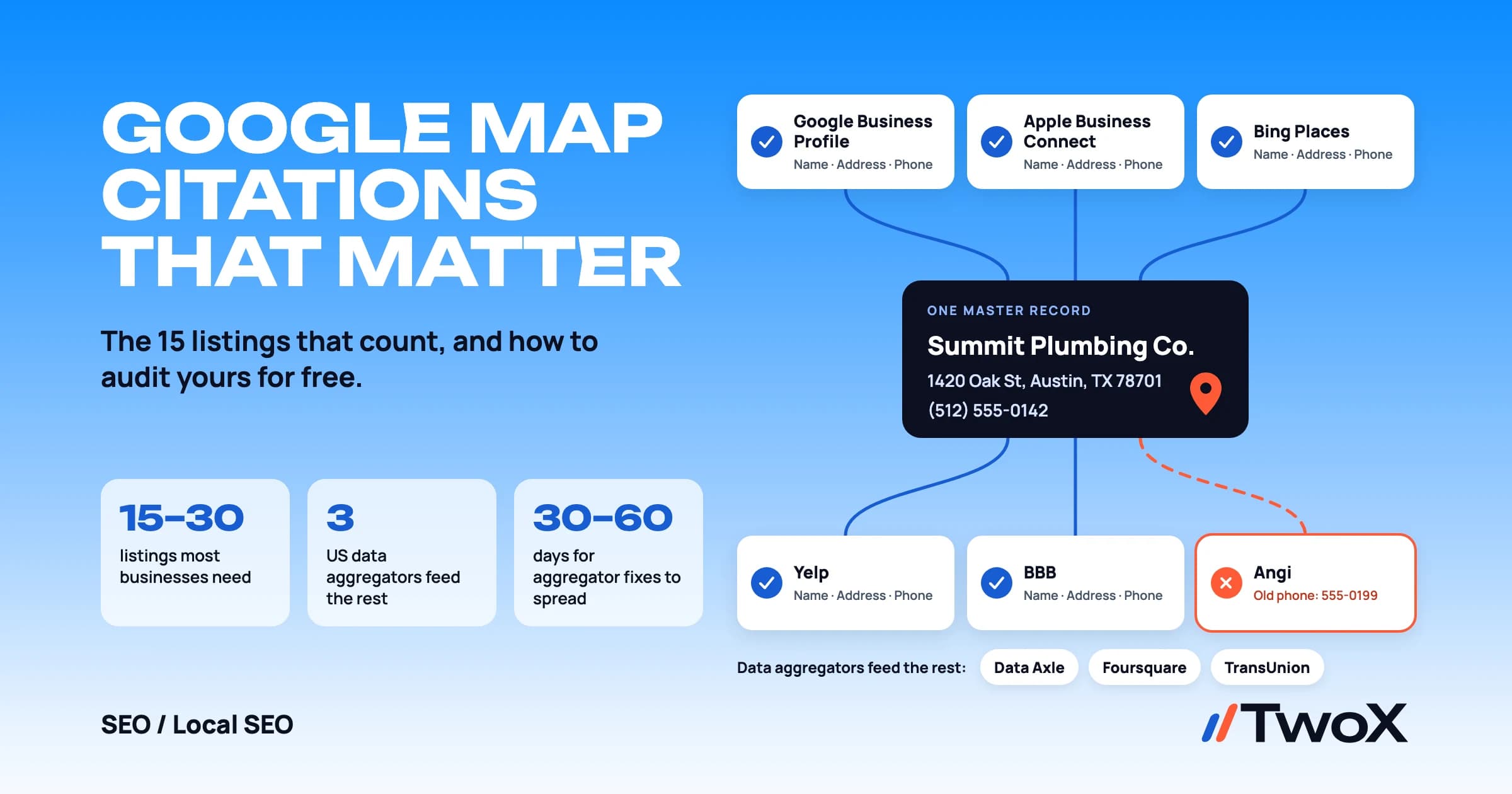
Tier 1: Data aggregators. You rarely see these directly, but they feed business data to hundreds of apps, directories, navigation systems, and search platforms. Fix your data here and it spreads downstream. Leave an error here and it keeps overwriting your manual fixes. The three that matter in the US are Data Axle, Foursquare, and TransUnion Digital Business Profile — the product formerly known as Neustar Localeze. Foursquare closed its public City Guide website in April 2025, so its listings no longer have a public page, but its data still feeds other apps. BrightLocal’s aggregator guide covers the submission process for each.
Tier 2: Core platforms. These are the Google maps citations that carry real weight — the six places customers actually look up businesses and that Google, Apple, and AI tools pull from: Google Business Profile, Apple Business Connect, Bing Places, Yelp, Facebook, and the BBB. If you do nothing else, get these six exactly right.
Tier 3: Industry and local directories. Angi, Thumbtack, and Houzz for home services; Avvo for lawyers; Healthgrades for medical practices; Nextdoor for neighborhood trades; your Chamber of Commerce. Worth doing for the two or three that matter in your trade. Their contribution to Map Pack rankings is small — single-digit percentages at best — but a top industry directory often ranks on page one for your own service searches, and that is traffic.
Everything beyond that — generic directories you have never heard of, «business listing» sites with no visitors — contributes close to nothing. Skip it.
The 15 citations worth building
| Platform | Tier | Link to your site | Profile indexed | Feeds other platforms | Cost | Who needs it |
|---|---|---|---|---|---|---|
| Data Axle | 1 | No public profile | No public profile | Yes | Free submission | Every business |
| Foursquare | 1 | No public profile (City Guide closed April 2025) | No public profile | Yes | Free to claim | Every business |
| TransUnion Digital Business Profile (Localeze) | 1 | No public profile | No public profile | Yes | $99/year per location | Every business |
| Google Business Profile | 2 | n/a | n/a | — | Free | Every business |
| Apple Business Connect | 2 | Nofollow | Yes | — | Free | Every business |
| Bing Places | 2 | Nofollow (redirect) | No | — | Free | Every business |
| Yelp | 2 | Nofollow (redirect) | Partly | — | Free listing, ads paid | Every business |
| 2 | Nofollow | Yes | — | Free | Every business | |
| BBB | 2 | Nofollow | Yes | — | Free listing, accreditation paid | Every business, especially home services |
| Nextdoor | 3 | Nofollow | Yes | — | Free business page | Neighborhood trades |
| Angi | 3 | Not checked* | Yes | — | Free profile, leads paid | Home services |
| Thumbtack | 3 | No link | Yes | — | Pay per lead | Home services |
| Houzz | 3 | Redirect, blocked in robots.txt | Yes | — | Free profile | Remodeling, design, construction |
| Avvo | 3 | Not checked* | Yes | — | Free profile | Lawyers |
| Healthgrades | 3 | Dofollow, on some profiles | Yes | — | Free for providers | Medical practices |
Link and indexing columns checked by TwoX Digital in October 2026 on live profiles and with Ahrefs outbound-link data. *Angi and Avvo block automated checks, so we could not record the link type; open your own profile and check the rel attribute on the website link.
A note on the link column, since it is the question we get most: citations do not need to be dofollow to count. Google reads the name, address, and phone number on the page whether the link passes authority or not. The consistency is the signal. A nofollow Yelp listing with correct details is worth far more than a dofollow listing on a site nobody visits.
Why NAP Consistency Is the Whole Point
NAP consistency means your name, address, and phone number appear the same way everywhere. Google compares these details across sources. When they match, each citation reinforces the others. When they conflict, Google has to decide which version is true — and a business with three versions of its address looks less certain than one with a single, slightly incomplete version.
What counts as a conflict is stricter than most people expect:
| Detail | Consistent | Inconsistent |
|---|---|---|
| Suite number | «Suite 200» everywhere | «Suite 200» on one site, «Ste. 200» on another, «#200» on a third |
| Business name | «Harbor Plumbing» everywhere | «Harbor Plumbing LLC», «Harbor Plumbing & Drain», «Harbor Plumbing — Tampa» |
| Phone | One local number everywhere | A call-tracking number on some listings, the main line on others |
| Website | https://harborplumbing.com | An old domain, a Facebook page, or a URL with tracking parameters |
| Address after a move | Current address everywhere | Old address still live on five directories |
Small formatting differences like «Ste.» versus «Suite» are usually read correctly by Google. The ones that genuinely hurt are real conflicts: a second phone number, an old address, a different business name. Those tell Google there might be two businesses.
The fix is a NAP master document — one reference you copy from every time you create or edit a listing. It should hold:
- Business name, exactly as it appears on your Google Business Profile and legal documents
- Address in USPS format — Data Axle follows it, and matching it avoids aggregator-level mismatches
- One primary local phone number
- Website URL, with or without «www», but always the same
- Primary category and a 250-character and 750-character business description
- Hours, including how you list holiday hours
Keep it in a shared file. Every person who touches your listings uses it.
How to Audit the Citations You Already Have (Free)
A local citation audit shows you what already exists before you build anything new. Most businesses that have operated for a few years have listings they never created — auto-generated from aggregator data, set up by a former employee, or left behind by an old marketing vendor.
You can do a thorough audit with Google search operators and a spreadsheet.
- Search your phone number in every format. Run
"813-555-0142" -site:yourdomain.com, then"(813) 555-0142", then"8135550142". Directories format numbers differently, and each search surfaces different listings. The-site:part removes your own website from results. - Search every old phone number and tracking number you have ever used. This is where the worst inconsistencies hide.
- Search your old address in quotes —
"1450 Bay Street" Tampa— if you have ever moved. Every result is a listing still pointing customers to the wrong place. - Search your previous business names and common misspellings of your current one.
- Check the 15 platforms in the table above directly. Search each one for your business name. Note whether a listing exists, whether you have access, and whether the details match your master document.
- Check the aggregators. None of the three has a public listing page to search, so check them from the inside: claim or log in to your record with each one and compare it with your master document. What they hold is what the downstream ecosystem will keep receiving.
Log everything in a spreadsheet with these columns: platform, listing URL, name as shown, address as shown, phone as shown, website as shown, do you have access (yes / no / unknown), action needed.
For a typical service business that has operated for five years or more, expect to find 20 to 60 listings, and several with outdated information.
Fixing What’s Broken: Duplicates, Old Addresses, Lost Logins
Fix in this order, because each layer overwrites the one below it:
- Aggregators first. If Data Axle still has your old address, it will push that address back onto directories you already corrected. Fix the source before the branches.
- Core platforms second. Google, Apple, Bing, Yelp, Facebook, BBB.
- Industry and local directories last.
Lost access to a listing. Most platforms have a claim process — search the listing, request ownership, verify by phone, email, or postcard. If the listing was created under a former employee’s or vendor’s account, you usually need to claim it fresh rather than recover the old login. Keep every new login in one password manager tied to a company email address, not a personal one.
Moved or changed phone number. Update your Google Business Profile first, then the aggregators, then the core platforms. Do not delete old listings — edit them to the new details. Deleting leaves a gap that aggregator data can refill with the old information.
Duplicate listings. Two listings for the same business split your reviews and confuse both Google and customers. On most directories you can request a merge or report the duplicate. Duplicates on Google Business Profile itself are a different and more serious problem.
Service-Area Businesses: What to Do When Your Address Is Hidden
If you run a service-area business — plumber, roofer, cleaner, car service — Google tells you to hide your address on your Business Profile if customers never visit you. Its guidelines use a plumber working from home as the example. But many directories require an address to create a listing.
The rules:
- Use the same real address you verified your Google Business Profile with. Consistency applies even to details customers never see, because Google still compares them.
- Hide the address wherever the directory allows it. Yelp, Bing Places, and several others let you list a service area and keep the street address private.
- Where the address is mandatory and public, decide deliberately. For a home address, you may prefer to skip that directory. Missing one Tier 3 listing costs far less than publishing your home address.
- Never use a virtual office, a mailbox store, or a coworking desk. Google’s guidelines prohibit these for Business Profiles, and spreading one across 30 directories makes an eventual suspension much harder to reverse.
- List the same service areas everywhere a directory asks for them.
Hidden-address setups break in other ways too — we covered them in detail in when your service-area business doesn’t show on Maps.
«500 Citations for $99» — What You Are Actually Buying
If you have searched for citation building services, you have seen the offer. Here is what is usually behind it.
Sites with no traffic. To reach 500, vendors pad the list with generic directories and networks of near-identical sites. Most get no visitors, many are not indexed, and some are built purely to sell listings.
Listings you cannot edit. Bulk services often create listings under their own accounts. When you move or change phone numbers, you cannot update them — and you now have hundreds of outdated citations you do not control.
Duplicates you pay to remove. Bulk tools create new listings instead of claiming existing ones. You end up with two or three versions of your business on the same sites, which is exactly the inconsistency you were trying to fix.
Data that disappears when you stop paying. Some subscription listing tools push your data only while the subscription is active. Cancel, and listings can revert to whatever the aggregators hold.
Local citation building is worth paying for when it buys you time on the listings that matter, not volume on the ones that do not:
| Approach | Typical cost | Time | What you control afterward |
|---|---|---|---|
| DIY using this guide | $0 plus 10-20 hours | 2-4 weeks | Everything, under your own logins |
| Listing management tool | Usually a few hundred dollars per year per location | Days | Everything, while subscribed; check cancellation terms |
| One-time manual citation service | Usually a few dollars per listing | 2-6 weeks | Depends: insist on logins in your name |
| Agency, as part of local SEO | Part of a monthly retainer | Ongoing | Everything, if the agency sets it up in your name |
| Bulk «500 citations» package | $50-150 | Days | Almost nothing |
Whatever you choose, ask one question before paying: will every listing be created or claimed under an account I own? If the answer is no, walk away.
Citations Now Feed AI Answers Too
This is the part of citation work that has become more important, not less.
When someone asks ChatGPT, Perplexity, or Google’s AI Mode for «a reliable plumber in Tampa» or «the phone number for Harbor Plumbing,» the answer is built from what those systems find across the web. Directory listings are a large part of that. SE Ranking’s research found that businesses with Yelp and Trustpilot profiles were about three times more likely to be cited by ChatGPT. Whitespark’s 2026 report reached the same conclusion from a different direction: three of the top five AI search visibility factors are citation-related.
The risk runs both ways. If your old phone number is still live on a dozen directories, an AI assistant can confidently hand that old number to a customer. There is no search results page for the customer to double-check — just one answer, stated as fact.
So NAP consistency is no longer just about Map Pack rankings. It decides what AI systems say about your business. We cover the wider picture in our guide to how citations feed AI answers and Answer Engine Optimization.
How Long Fixes Take
These are typical ranges from our work. Aggregator changes are the slowest because they propagate in cycles.
| Action | Typical time to show up | How to check it worked |
|---|---|---|
| Edit a listing you control (Yelp, Bing, Facebook) | Days | Open the listing in a logged-out browser |
| Edit Google Business Profile details | Days, sometimes after a review | Search your business in an incognito window |
| Correct data at an aggregator | 30-60 days to spread downstream | Re-run phone and address searches after a month |
| Claim a listing via postcard | 1-3 weeks | Listing shows as claimed in your account |
| Remove or merge a duplicate directory listing | 1-4 weeks | Duplicate no longer appears in a site: search |
| Clean up NAP across the full citation set | 2-3 months to settle | Old phone and address searches return no results |
| AI assistants reflect corrected details | Unpredictable, often months | Ask ChatGPT and Perplexity for your phone number and address |
Two rules: fix aggregators first so your manual edits stick, and re-run the same audit searches after 60 days so you are measuring against the same baseline.
A real example of the order working: for Yara Space & Hair Spa, a salon we took from no online presence to the top of the Map Pack for its main local search in about six months, citations were built alongside the profile and review system from day one — core platforms first, then the leading national directory, all from one master document. None of the citations needed fixing later, because none were ever inconsistent.
Get Your Citations Audited
We run a free local SEO audit that includes a citation check: we find your existing listings, flag every inconsistency, and tell you which ones to fix first and which to ignore. If you want the work done for you, it is part of our local SEO for service businesses — built under accounts you own, from one master document.
No commitment. You keep the audit either way.
TwoX Digital is a digital marketing agency specializing in SEO, AEO, GEO, and PPC for businesses in the US and English-speaking markets.